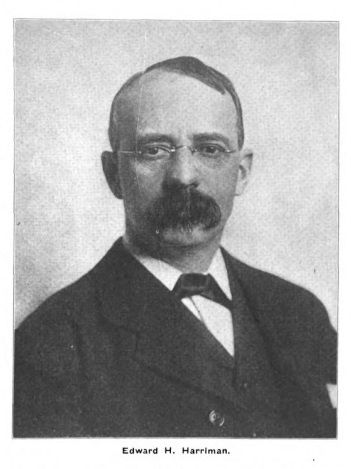
Railroad executive and financier. Born in Hempstead, New York, on February 20, 1848, he entered the business world at an early age, working in a brokerage office by fourteen. Through skill and ambition, he purchased his own seat on the New York Stock Exchange in his early twenties and began investing in railroads, laying the foundation for one of the great American transportation empires of the early twentieth century. In 1879, he married Mary Williamson Averell, daughter of William J. Averell, president of the Ogdensburg and Lake Champlain Railroad, a union that strengthened his business connections in the rail industry. He steadily acquired controlling interests in several major lines, including the Union Pacific, Southern Pacific, and Illinois Central railroads. His leadership brought financial stability and large-scale reorganization to these systems, helping modernize railroad management and expand national freight routes. He also sponsored scientific and geographic exploration, notably the 1899 Harriman Alaska Expedition, which combined research in zoology, botany, and geology with the documentation of the Alaskan coastline. His efforts reflected a broader interest in conservation and industrial efficiency that influenced early twentieth-century infrastructure and environmental study. He died at his Arden estate in Orange County, New York, on September 9, 1909, at the age of sixty-one and was buried in Saint John's Episcopal Church Cemetery, Arden, New York.
Railroad executive and financier. Born in Hempstead, New York, on February 20, 1848, he entered the business world at an early age, working in a brokerage office by fourteen. Through skill and ambition, he purchased his own seat on the New York Stock Exchange in his early twenties and began investing in railroads, laying the foundation for one of the great American transportation empires of the early twentieth century. In 1879, he married Mary Williamson Averell, daughter of William J. Averell, president of the Ogdensburg and Lake Champlain Railroad, a union that strengthened his business connections in the rail industry. He steadily acquired controlling interests in several major lines, including the Union Pacific, Southern Pacific, and Illinois Central railroads. His leadership brought financial stability and large-scale reorganization to these systems, helping modernize railroad management and expand national freight routes. He also sponsored scientific and geographic exploration, notably the 1899 Harriman Alaska Expedition, which combined research in zoology, botany, and geology with the documentation of the Alaskan coastline. His efforts reflected a broader interest in conservation and industrial efficiency that influenced early twentieth-century infrastructure and environmental study. He died at his Arden estate in Orange County, New York, on September 9, 1909, at the age of sixty-one and was buried in Saint John's Episcopal Church Cemetery, Arden, New York.
Bio by: Stories Among The Stones
Inscription
Son Of Orlando Harriman and Cornelia Neilson "The Spirit Shall Return Unto God Who Gave It Death Is Swallowed Up In Victory"