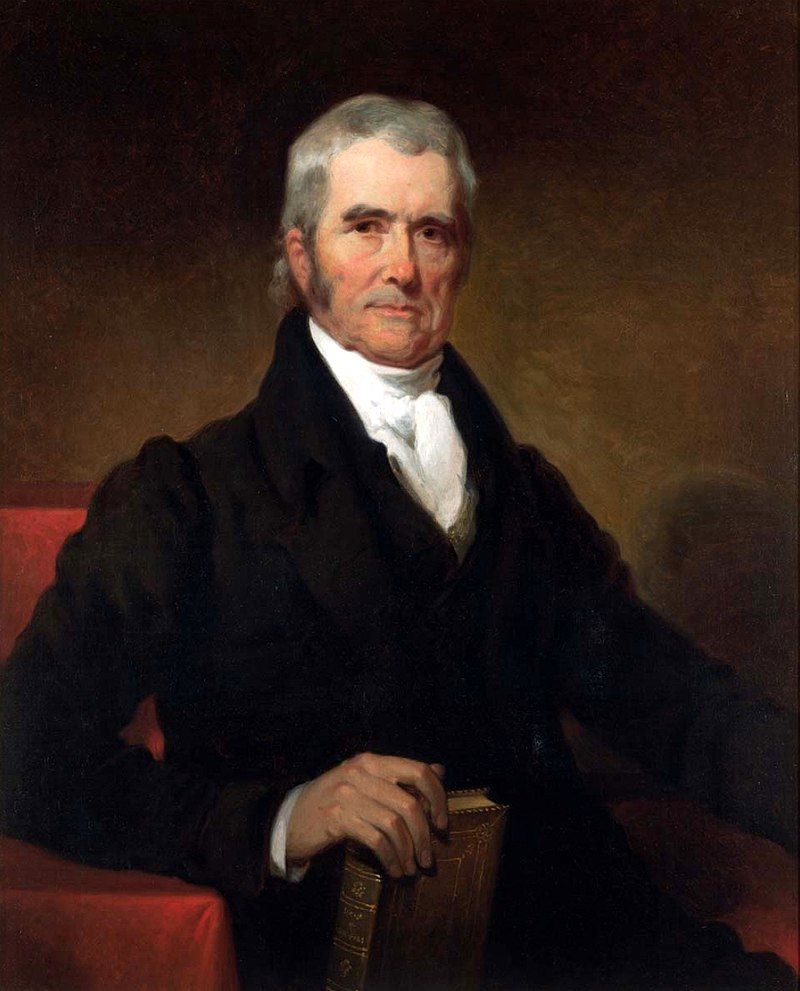
United States Congressman, Secretary of State, and Supreme Court Justice. A member of the Federalist Party, he served in the United States House of Representatives for Virginia's 13th Congressional District from March 1799 until June 1800.
The oldest of 15 children, he lived in a two-room log cabin in his early years and didn't receive a formal education. When the American Revolution broke out in 1775, he served as a Captain in the Continental Army under General George Washington. After being furloughed in 1780, he attended the College of William and Mary in Williamsburg, Virginia, and studied law. He was admitted to the bar and established a law practice. In 1782, he entered politics, and was elected to the Virginia House of Delegates. Following his election to Congress, President John Adams nominated him as the United States Secretary of State, serving briefly from June 1800 until March 1801. During this time, he helped to bring an end to the Quasi-War, an undeclared naval war between the United States and France from 1798 to 1800, through the signing of the Convention of 1800.
In January 1801, he was nominated by Adams to become the Chief Justice of the United States Supreme Court, replacing Oliver Ellsworth who resigned because of poor health. His nomination was approved by the United States Senate. He took office on February 4, 1801, and served until his death. His Court's first case, and probably what he is best remembered for, was the 1803 case of Marbury v. Madison, in which he upheld the principle of judicial review, whereby courts could strike down federal and state laws if they conflicted with the United States Constitution. This decision helped implement the principle of separation of powers and affirm the position of the United States Supreme Court as an independent and co-equal branch of government. He died at the age of 79, following a surgical procedure, and was succeeded as Chief Justice by Roger B. Taney.
United States Congressman, Secretary of State, and Supreme Court Justice. A member of the Federalist Party, he served in the United States House of Representatives for Virginia's 13th Congressional District from March 1799 until June 1800.
The oldest of 15 children, he lived in a two-room log cabin in his early years and didn't receive a formal education. When the American Revolution broke out in 1775, he served as a Captain in the Continental Army under General George Washington. After being furloughed in 1780, he attended the College of William and Mary in Williamsburg, Virginia, and studied law. He was admitted to the bar and established a law practice. In 1782, he entered politics, and was elected to the Virginia House of Delegates. Following his election to Congress, President John Adams nominated him as the United States Secretary of State, serving briefly from June 1800 until March 1801. During this time, he helped to bring an end to the Quasi-War, an undeclared naval war between the United States and France from 1798 to 1800, through the signing of the Convention of 1800.
In January 1801, he was nominated by Adams to become the Chief Justice of the United States Supreme Court, replacing Oliver Ellsworth who resigned because of poor health. His nomination was approved by the United States Senate. He took office on February 4, 1801, and served until his death. His Court's first case, and probably what he is best remembered for, was the 1803 case of Marbury v. Madison, in which he upheld the principle of judicial review, whereby courts could strike down federal and state laws if they conflicted with the United States Constitution. This decision helped implement the principle of separation of powers and affirm the position of the United States Supreme Court as an independent and co-equal branch of government. He died at the age of 79, following a surgical procedure, and was succeeded as Chief Justice by Roger B. Taney.
Bio by: William Bjornstad
Family Members


-
![]()
Elizabeth Marshall Colston
1756–1843
-
Mary Ann Marshall Marshall
1757–1824
-
![]()
Capt Thomas Marshall Jr
1761–1817
-
![]()
James Markham Marshall
1764–1848
-
Judith Marshall Brooke
1766–1809
-
![]()
William Marshall
1767–1816
-
Charles Fleming Marshall
1767–1805
-
Lucy Marshall Ambler
1768–1795
-
Alexander Keith Marshall
1770–1825
-
![]()
Dr Louis Marshall
1772–1866
-
Susanna Tarleton Marshall McClung
1774–1858
-
Charlotte Ashmore Marshall Duke
1777–1817
-
![]()
Jane "Aunt Taylor" Marshall Taylor
1779–1866
-
Nancy Marshall Daviess
1781–1860