
Yellow-shouldered Grassquit Loxipasser anoxanthus Scientific name definitions
- LC Least Concern
- Names (22)
- Monotypic
Text last updated July 30, 2018
Sign in to see your badges
Species names in eBird-supported languages
| Language | Common name |
|---|---|
| Bulgarian | Жълтораменна тъпочовка |
| Catalan | menjagrà de Jamaica |
| Croatian | zelenoleđi sjemenar |
| Danish | Gulskuldret Græsfinke |
| Dutch | Jamaicaanse grondvink |
| English | Yellow-shouldered Grassquit |
| English (AVI) | Yellow-shouldered Grassquit |
| English (United States) | Yellow-shouldered Grassquit |
| Finnish | jamaikansirkkunen |
| French | Pèrenoir mantelé |
| German | Goldbug-Gimpeltangare |
| Japanese | キゴロモコメワリ |
| Norwegian | gulryggspurv |
| Polish | jamajczyk |
| Russian | Ямайский семилеро |
| Serbian | Žutopleći graskvit |
| Slovak | ostrovčan žltoplecí |
| Spanish | Semillero Jamaicano |
| Spanish (Spain) | Semillero jamaicano |
| Swedish | jamaicatangara |
| Turkish | Sarı Omuzlu Tohumcul |
| Ukrainian | Ямайчик |
Loxipasser anoxanthus (Gosse, 1847)
Definitions
- LOXIPASSER
- anoxantha / anoxanthus
The Key to Scientific Names
Legend Overview
Originally Appeared in

Full content is available exclusively to Birds of the World subscribers. Sign in Learn more
Introduction
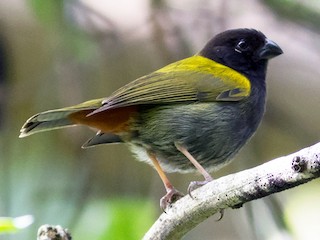
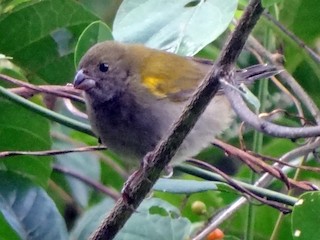
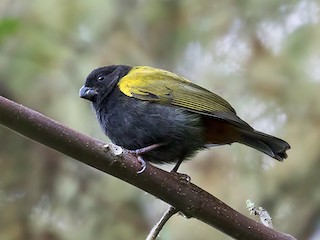
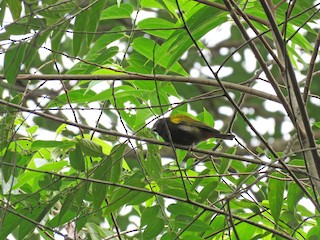
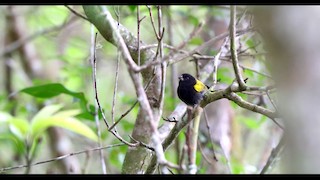
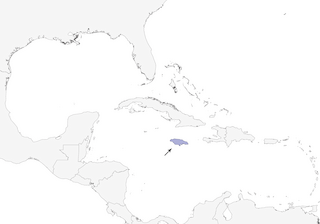
Just one of several genera that are endemic to Jamaica, the Yellow-shouldered Grassquit is the sole member of Loxipasser. It shares the island with two other, even more widespread grassquits, the Black-faced Grassquit (Tiaris bicolor) and the Yellow-faced Grassquit (Tiaris olivaceus), but the present species is distinctly more arboreal than either of the latter two. Males are charcoal black over the head and neck, becoming paler over the rest of the underparts, with chestnut undertail coverts, whilst the upper back and wing coverts are bright yellow. Females are quite different, being mainly dull olive on the head, with gray underparts, and only the carpal area is bright yellow. The Yellow-shouldered Grassquit generally is found in well-forested areas in the highlands of Jamaica, but it wanders to lower elevations in the post-breeding season, and will visit well-vegetated gardens and dense scrub at any time of year.
Subspecies
- Year-round
- Migration
- Breeding
- Non-Breeding