

Markets
Visualizing a Global Shift in Wealth Over 10 Years


Visualizing a Global Shift in Wealth Over 10 years
The Chart of the Week is a weekly Visual Capitalist feature on Fridays.
The world has now accumulated $215 trillion in private wealth, a 12% increase over 2017, according to the latest report by market research company New World Wealth.
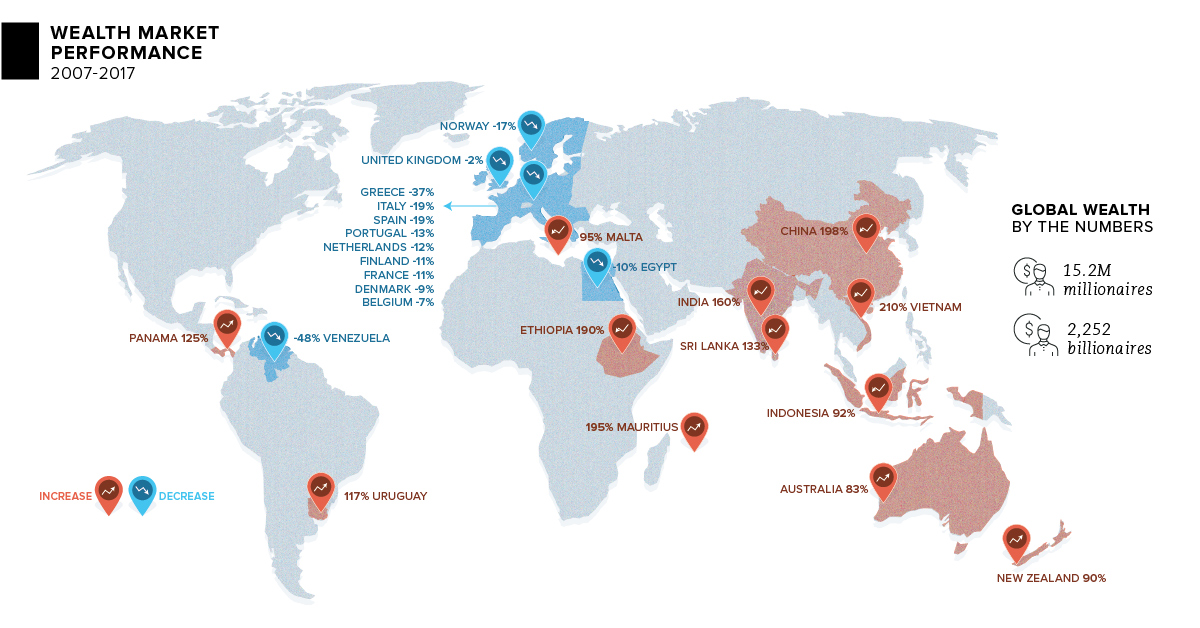
This number today includes wealth held by the general population, as well as the 15.2M millionaires ($1M+ in assets), 584,000 multi-millionaires ($10M+ in assets), and 2,252 billionaires ($1B+ in assets) in the world.
But the picture of global wealth hasn’t always been constant – in fact, it’s always shifting based on market performance, the movement of high net worth individuals (HNWIs), demographic trends, and other factors.
Top Countries Adding Wealth
Over the last decade, from 2007 to 2017, here are the top countries based on percentage of new wealth added (in $USD terms):
| Rank | Country | Wealth Growth (2007-2017) |
|---|---|---|
| #1 | Vietnam | 210% |
| #2 | China | 198% |
| #3 | Mauritius | 195% |
| #4 | Ethiopia | 190% |
| #5 | India | 160% |
| #6 | Sri Lanka | 133% |
| #7 | Panama | 125% |
| #8 | Uruguay | 117% |
| #9 | Malta | 95% |
| #10 | Indonesia | 92% |
Not surprisingly, plenty of developing markets made this list.
Vietnam, which had a 210% growth in wealth held over the last decade, is an emerging manufacturing hub. The market is projected by New World Wealth to grow a further 200% in the next 10 years, bolstered by strong growth in its local healthcare, manufacturing, and financial services sectors.
The small island nation of Mauritius is one of Africa’s brightest success stories, with a 195% growth in wealth over the last 10 years. With favorable tax policies, beautiful beaches, and better relative safety ratings, HNWIs have been moving to the island en masse.
Just missing the Top 10 list above are two developed economies: New Zealand and Australia. Interestingly, these two markets grew in wealth 90% and 83% respectively over the last decade, which is extremely impressive for countries that already had a solid base of wealth to start with.
Countries That Lost Wealth
Here are the markets that saw total wealth decrease over the last 10 years, in terms of U.S. dollars.
| Rank | Country | Wealth Growth (2007-2017) |
|---|---|---|
| #1 | Venezuela | -48% |
| #2 | Greece | -37% |
| #3 | Italy | -19% |
| #4 | Spain | -19% |
| #5 | Norway | -17% |
| #6 | Portugal | -13% |
| #7 | Netherlands | -12% |
| #8 | France | -11% |
| #9 | Finland | -11% |
| #10 | Egypt | -10% |
The crisis in Venezuela had a particularly rough impact on wealth. The country, which was once the richest in South America, lost 48% of its wealth in $USD terms over the last decade.
It’s also worth mentioning that many of the countries that saw wealth decrease over this time period are European – that’s because the 2008 financial crisis (and the ensuing sovereign debt crisis) hit Europe particularly hard.
Greece bore the brunt of this impact, losing 37% of its wealth in the 2007-2017 period.


Finance
Ranked: Europe’s Biggest Banks by Assets
Half of Europe’s ten biggest banks by total assets are located in one country, and it’s neither Switzerland nor the UK.


Ranked: Europe’s Biggest Banks by Assets
See visuals like this from many other data creators on our Voronoi app. Download it for free on iOS or Android and discover incredible data-driven charts from a variety of trusted sources.
Key Takeaways
- BNP Paribas is Europe’s largest bank, with $3.3 trillion in assets as of December 2025.
- Five of Europe’s 10 biggest banks are headquartered in France, more than any other country.
- Despite Germany’s status as Europe’s largest economy, Deutsche Bank ranks only eighth by assets.
The most famous banks in the world may be American, but some of the oldest are to be found in Europe. And as it turns out, France may well be the banking capital of the continent.
Using the latest data from S&P Global, this graphic ranks the 20 largest European banks by total assets as of December 2025.
France Is Home to Europe’s Biggest Banks
London and Zurich may be among Europe’s best-known financial centers, but France is home to half of the continent’s 10 largest banks by assets.
The table below ranks the 20 largest European banks by total assets in December 2025.
| Current Rank | Company | Total Assets ($B) |
|---|---|---|
| 1 | 🇫🇷 BNP Paribas | 3,279 |
| 2 | 🇬🇧 HSBC | 3,212 |
| 3 | 🇫🇷 Crédit Agricole Group | 3,149 |
| 4 | 🇪🇸 Banco Santander | 2,252 |
| 5 | 🇬🇧 Barclays | 2,078 |
| 6 | 🇫🇷 Groupe BPCE | 1,987 |
| 7 | 🇫🇷 Société Générale | 1,813 |
| 8 | 🇩🇪 Deutsche Bank | 1,685 |
| 9 | 🇨🇭 UBS Group | 1,617 |
| 10 | 🇫🇷 Crédit Mutuel Group | 1,442 |
| 11 | 🇬🇧 Lloyds Banking Group | 1,271 |
| 12 | 🇳🇱 ING Groep | 1,238 |
| 13 | 🇮🇹 Intesa Sanpaolo | 1,127 |
| 14 | 🇮🇹 UniCredit | 1,022 |
| 15 | 🇪🇸 BBVA | 1,006 |
| 16 | 🇬🇧 NatWest Group | 962 |
| 17 | 🇬🇧 Standard Chartered | 920 |
| 18 | 🇷🇺 Sberbank of Russia | 870 |
| 19 | 🇫🇷 La Banque Postale | 852 |
| 20 | 🇪🇸 CaixaBank | 780 |
BNP Paribas was formed through a 2000 merger between two of France’s largest banks, Banque Nationale de Paris (BNP) and Paribas. BlackRock and the Belgian government both hold minority stakes in the bank, which maintained a U.S. retail banking presence until 2019.
France is also home to Crédit Agricole ($3.1 trillion), BPCE ($2 trillion), Société Générale ($1.8 trillion), and Crédit Mutuel ($1.4 trillion).
The Traditional Banking Hubs
Europe’s second- and fifth-largest banks are headquartered in the United Kingdom. HSBC has $3.2 trillion in assets, while Barclays has $2.1 trillion.
London’s historical position as a European financial center faced new challenges following the UK’s 2020 withdrawal from the European Union. Both banks spent hundreds of millions of pounds responding to the UK’s departure from the European common market.
Other major British banks include Lloyds ($1.3 trillion), NatWest Group ($962 billion), and Standard Chartered ($920 billion).
Germany’s Decentralized Banking Sector
Germany, Europe’s largest economy, has only one bank among the continent’s 20 largest by total assets. Deutsche Bank ranks eighth with $1.7 trillion and is dual-listed on the Frankfurt and New York stock exchanges.
Germany’s decentralized banking system is deliberate. Rather than relying on a few financial giants, the country has a three-pillar system consisting of private commercial banks, regional public savings banks, and cooperative credit unions.
By comparison, Spain has three banks in Europe’s top 20: Santander ($2.3 trillion), BBVA ($1 trillion), and CaixaBank ($780 billion). All three have extensive retail operations, with Santander and BBVA maintaining particularly large international footprints.
Learn More on the Voronoi App 
Learn how these banks stack up against the rest of the world on Voronoi, the new app from Visual Capitalist.
Brands
Ranked: The World’s Most Valuable Restaurant Chains
McDonald’s is by far the largest public restaurant chain in the world, with a nearly $200 billion market capitalization.


Ranked: The World’s Most Valuable Restaurant Chains
See visuals like this from many other data creators on our Voronoi app. Download it for free on iOS or Android and discover incredible data-driven charts from a variety of trusted sources.
Key Takeaways
- McDonald’s is the world’s most valuable restaurant chain, with a market capitalization of $195.1 billion—more than the next eight companies combined.
- Chipotle and Yum! Brands round out the top three, each valued at roughly $45 billion.
- U.S.-based companies account for 11 of the world’s 20 most valuable public restaurant chains.
The global restaurant industry is dominated by a few multinational chains, especially American ones. One company sits well ahead of its competition.
This graphic ranks the top 20 public restaurant companies by market capitalization as of July 2026, using data from CompaniesMarketCap. Only publicly traded companies are included.
The Golden Arches and a Golden Valuation
At $195.1 billion, McDonald’s is valued at more than four times Chipotle, the second-largest company in the ranking. Its global franchise network, brand recognition, and consistent profitability have helped it build an unmatched valuation in the restaurant industry.
The table below ranks the most valuable restaurant companies by market capitalization as of July 2026.
| Rank | Restaurant Name | Market Cap (billions $) |
|---|---|---|
| 1 | 🇺🇸 McDonald's | 195.1 |
| 2 | 🇺🇸 Chipotle Mexican Grill | 45.2 |
| 3 | 🇺🇸 Yum! Brands | 45.1 |
| 4 | 🇨🇦 Restaurant Brands International | 34.3 |
| 5 | 🇺🇸 Darden Restaurants | 23.4 |
| 6 | 🇨🇳 Yum China | 14.8 |
| 7 | 🇺🇸 Texas Roadhouse | 12.5 |
| 8 | 🇺🇸 Domino's Pizza | 10 |
| 9 | 🇯🇵 Zensho Holdings | 8.5 |
| 10 | 🇺🇸 CAVA Group | 8.4 |
| 11 | 🇺🇸 Brinker International | 7.9 |
| 12 | 🇨🇳 Hai Di Lao Hot Pot | 7.6 |
| 13 | 🇯🇵 Food & Life Companies | 6.8 |
| 14 | 🇯🇵 McDonald's Japan | 6.3 |
| 15 | 🇦🇪 Americana Restaurants International | 4.7 |
| 16 | 🇺🇸 Wingstop Restaurants | 4.2 |
| 17 | 🇺🇸 The Cheesecake Factory | 4.1 |
| 18 | 🇯🇵 Skylark Holdings | 4.1 |
| 19 | 🇵🇭 Jollibee | 2.7 |
| 20 | 🇺🇸 Shake Shack | 2.5 |
McDonald’s was founded in 1940 by two brothers in San Bernardino, California, and expanded overseas within a few decades. The company now has more than 40,000 locations worldwide, with particularly large footprints in the U.S., China, and Japan.
The company’s Japanese subsidiary alone has a market capitalization of $6.3 billion. Den Fujita founded the local subsidiary and opened Japan’s first McDonald’s restaurant in 1971.
U.S. Restaurant Hegemony
The next two companies in the ranking, Chipotle ($45.2 billion) and Yum! Brands ($45.1 billion), are also based in the United States. Overall, American companies account for 11 of the top 20, including fast-growing CAVA ($8.4 billion).
Chipotle was founded as an early fast-casual restaurant in Denver, Colorado, in 1993. McDonald’s owned a 90% majority stake in the company before divesting in 2006.
Meanwhile, Yum! Brands is a Louisville-based fast-food corporation that owns major chains including Pizza Hut, Taco Bell, and Kentucky Fried Chicken (KFC). Its Chinese subsidiary was spun off in 2016 and has a market capitalization of $14.8 billion a decade later.
The Most Valuable Non-American Restaurant Companies
Several international restaurant groups have also built multibillion-dollar valuations.
Restaurant Brands International (RBI) is a Canadian company valued at $34.3 billion that operates major restaurant chains including Burger King, Popeyes, and Tim Hortons. Americana Restaurants International, a UAE-based company valued at $4.7 billion, has similarly diverse fast-food holdings and is 50% owned by Saudi Arabia’s Public Investment Fund.
Other highly valued restaurant companies are based in East Asia, including China’s Haidilao ($7.6 billion) and Japan’s Zensho Holdings ($8.5 billion).
Learn More on the Voronoi App
Curious how one Mediterranean-inspired entry on this list is growing so rapidly? Check out Cava is valued at $35M per restaurant on Voronoi, the new app from Visual Capitalist.
-
 Agriculture4 weeks ago
Which States Produce the Most Food in America?
-
Sports4 days ago
Ranked: FIFA World Rankings After the 2026 Men’s World Cup
-
Travel6 days ago
Ranked: The Countries Gaining and Losing the Most Tourists
-
Cost of Living1 week ago
Ranked: The World’s Most and Least Livable Cities in 2026
-
Media4 weeks ago
Ranked: America’s Best-Selling Albums Ever
-
Media3 weeks ago
Ranked: The 50 Highest-Paid Creators in 2026
-
Wealth2 weeks ago
Ranked: The Richest Countries by Average vs. Median Wealth
-
Maps3 weeks ago
Mapped: America’s Favorite Dog Breed, By State


