


- For editing requests, please check this staff list and inform an Administrator or Content Moderator through their Message Wall.
- If you are involved in a content dispute, calmly talk to the user, which can be found in the page's history; try to find the cause of the problem and negotiate a compromise.
- Remember to adhere to our wiki's User Conduct Policy while communicating and/or sending your request.
Pikachu (ピカチュウ, Pikachu?) (PEE-ka-choo[1]) is an Electric-type Pokémon introduced in Generation I.
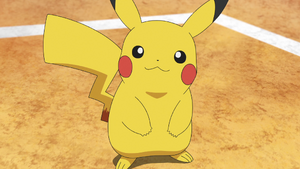
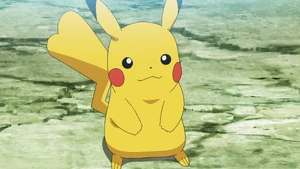
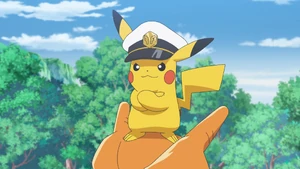
Pikachu is renowned for being the most well-known and recognizable Pokémon. Over the years, Pikachu has become so popular that it serves as the Pokémon mascot. In the games, Pikachu is the version mascot and first partner Pokémon of Pokémon Yellow Version: Special Pikachu Edition and its remake Pokémon: Let's Go, Pikachu!. In the anime, Pikachu appeared regularly as the main travel companion and partner to Ash Ketchum; while another variant, partners alongside Professor Friede in Pokémon Horizons: The Series.
Quick Answers
What type of Pokémon is Pikachu?

In which Pokémon games is Pikachu the Version Mascot?
How has Pikachu's popularity evolved over the years?
Biology
Physiology
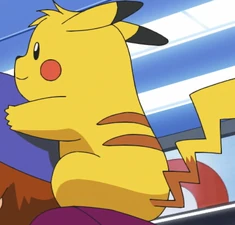
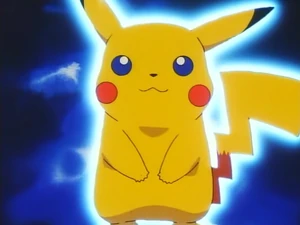
Pikachu are small, and cute mouse-like Pokémon. They are almost completely covered by yellow fur. They have long yellow ears that are tipped with black. A Pikachu's back has two brown stripes, and its large tail is notable for being shaped like a lightning bolt, yet its brown tip is almost always forgotten. Pikachu have short arms with five tiny fingers on forehands and three sharp fingers on their hind legs. On its cheeks are two red, circle-shaped pouches used for storing its electricity. They turn yellow and spark with electricity when it's about to use an Electric attack, such as Thunderbolt. It has also been known to generate small surges of electrical energy in anger or for protection, like in the anime.
A female Pikachu looks almost exactly the same as a male, with the exception of her tail, which is rounded at the end and has an inward dent, giving it the appearance of a heart. However, in earlier anime episodes, and in the games prior to Generation IV, female and male Pikachu look identical.
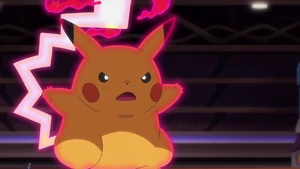
As Gigantamax Pikachu, it becomes larger and chubbier (similar to its Generation I design). Its tail becomes longer and stores all of the electricity it generates, causing it to glow a bright yellow and enabling it to become as powerful as a lightning strike. Its power is equal to that a power plant; however, it is difficult to use it in peoples' homes since Pikachu can only remain in its Gigantamax form for a short time.
When several of these Pokémon gather, their electricity can cause lightning storms.
A Shiny Pikachu is slightly orange.
In "A Plethora of Pikachu!", according to Pikala, the fur from Pikachu in the Kanto region sparkles in sunlight, while the Pikachu from Alola fur is silky smooth and shines in sunlight.
Behavior
Pikachu are usually friendly creatures that love to be cuddled. They love having their tails rubbed, especially at the base; they also like being stroked. However, if threatened or angered, this Pokémon can be quite aggressive. If someone pulls or steps on its tail, it is most likely it will bite or shock anyone in the area, including the one who pulled its tail.
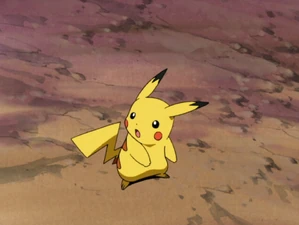
However, in the anime and in the wild of the Kanto region they live in big groups deep in forests and are wary of humans.
In Kanto according to Ash in "Gotta Catch a What?!", Pikachu also greet one another by shocking them and sometimes they'll gather up in big groups to search for Thunderstones so they can evolve.
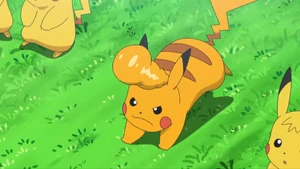
The Pikachu that live in the Pikachu Valley in Alola in the anime, greet each other by sniffing one another and rubbing their tails together. Also, they can start duels with one another by sending electrical signals and the winner is decided when the opponent's tail is bitten.
In the first five generations of core games, Pikachu uses electronic sounds like other Pokémon. An exception is Pokémon Yellow Version: Special Pikachu Edition, where Pikachu is voiced by Ikue Ōtani, the voice actress of Ash's Pikachu. However, from Pokémon X and Pokémon Y until Pokémon Brilliant Diamond and Pokémon Shining Pearl, Ōtani continued to portray Pikachu. Until Pokémon: Let's Go, Pikachu! and Pokémon: Let's Go, Eevee!, Pikachu was also the only Pokémon to use its cry from until Eevee in Pokémon: Let's Go, Pikachu! and Pokémon: Let's Go, Eevee!. Since Pokémon Legends: Arceus, the core games returned to using electronic sounds for Pikachu. Ōtani has sometimes portrayed Pikachu in other games, such as Pokémon Sleep.
Special abilities
Pikachu's special ability is Static, which can cause paralysis in battle if hit by a physical move. In Pokémon Black and White's Dream World, the Trainer receives a Pikachu with the Lightning Rod ability.
Pikachu are the only Pokémon that get value and can make use of the effects of the Light Ball held item in battle.
Pikachu are capable of learning Volt Tackle, a powerful Electric-type physical move exclusive to the Pikachu family of Pokémon.
Partner Pikachu is also capable to learning special moves: Zippy Zap, Floaty Fall, Splishy Splash, and the Partner Power, Pika Papow.
Z-Moves
Pikachu is one of the few Pokémon in Sun and Moon which have a special Z-Move dedicated to them.
The Z-Move Catastropika is Pikachu's signature move. The move is activated by the Z-Crystal, Pikanium Z. Its base is Volt Tackle. Catastropika can be learned only by a Pikachu with Volt Tackle, and becomes unusable if Volt Tackle is forgotten or if the Pikachu evolves into Raichu.
The Z-Move 10,000,000 Volt Thunderbolt is Ash Pikachu's signature move. The move is activated by the Z-Crystal, Pikashunium Z. Its base is Thunderbolt.
Pikachu, being an Electric-type, is capable of using the Z-Crystal, Electrium Z, to use the Z Move Gigavolt Havoc.
Gigantamax
Pikachu is one of the 32 Pokémon in Pokémon Sword and Pokémon Shield that can Gigantamax by having a special member from its species or, with the Isle of Armor Expansion Pass, using Max Soup on a Pikachu. Gigantamax Pikachu can also be obtained from having save data of on the same console, and talking to a certain non-playable character in the Wild Area Train Station.
Gigantamax Pikachu is the only known Pokémon capable of using the G-Max move, G-Max Volt Crash.
Evolution
Pikachu evolves from Pichu if leveled up with high friendship and evolves into either Raichu if it touches a Thunder Stone or Alolan Raichu if it touches a Thunder Stone in Alola. Pikachu can Gigantamax into Gigantamax Pikachu, and can be found in Cramorant's Gorging Form.
Game data by generation


Appearances
Core series
In the core series, Pikachu appears as a wild Pokémon in all games except Pokémon Yellow Version: Special Pikachu Edition, Pokémon Black Version and Pokémon White Version, and Pokémon Black Version 2 and Pokémon White Version 2. Since Pokémon Gold Version and Pokémon Silver Version, Pikachu can evolve when Pichu levels up at a friendship level, except in Pokémon: Let's Go, Pikachu! and Pokémon: Let's Go, Eevee!, in which Pichu does not appear.
Pokémon Red Version and Pokémon Blue Version
Pikachu has a low appearance rate in Pokémon Red Version and Pokémon Blue Version, but it is one of the few Electric-type Pokémon encountered in the Viridian Forest early on, but only with a 5 percent chance of appearing. Pikachu also appears at the Power Plant that can be accessed from the middle to late stages of the game.
Pokémon Yellow Version: Special Pikachu Edition
Pikachu is the only available first partner Pokémon in Pokémon Yellow Version: Special Pikachu Edition, and its relationship to the player is directly parallel to the relation between Ash's Pikachu to Ash Ketchum in the anime. Since it is a first partner Pokémon, no Pikachus appear as wild Pokémon, unlike in Pokémon Red Version and Pokémon Blue Version, but despite this, the Pikachu that would become the player's first partner Pokémon is encountered by Professor Oak as a wild Pokémon in the tall grass.
There is a minigame named Pikachu's Beach, where the player can use a surfing Pikachu obtained from Pokémon Stadium or a real-life event, but in the Virtual Console release, only the first-partner Pikachu can be used in the minigame. Regardless, the Pikachu used in the minigame can perform flips on a surfboard for points.
Pokémon Gold Version and Pokémon Silver Version
Starting with Pokémon Gold Version and Pokémon Silver Version, giving Pikachu a Light Ball doubles its Special Attack. In the wild, Pikachu can be found in Route 2.
Pokémon Emerald Version
From Pokémon Emerald Version, if the player gives a Light Ball to a Pikachu and leaves it at a Pokémon Day Care, they can hatch a Pichu that knows Volt Tackle, a move usable only by members of the Pikachu line.
Pokémon Diamond Version and Pokémon Pearl Version
Starting with Pokémon Diamond Version and Pokémon Pearl Version, giving Pikachu a Light Ball doubles not only its Special Attack but also its Attack, which makes it stronger than Raichu.
Pokémon HeartGold Version and Pokémon SoulSilver Version
In the Pokéwalker associated with Pokémon HeartGold Version and Pokémon SoulSilver Version, there is a route titled Yellow Forest, which consists entirely of Pikachus, and the promotional artwork shows fourteen Pikachus, one of which is riding balloons in the nearby background.
Pokémon Black Version / Pokémon White Version / Pokémon Black Version 2 / Pokémon White Version 2
Pokémon Black Version and Pokémon White Version as well as the sequels Pokémon Black Version 2 and Pokémon White Version 2 are the only core games where wild Pikachu do not appear. Obtaining a Pikachu requires the player to transfer one over from one of the Generation IV titles.
Pokémon: Let's Go, Pikachu!
A Pikachu is the first partner Pokémon in Pokémon: Let's Go, Pikachu!, and it is different than the Pikachu seen in Pokémon Yellow Version: Special Pikachu Edition. It is seen riding on the player's shoulder. Pikachu can be customized with different costumes.
Spinoffs
Pokémon Stadium series
Pokémon Stadium
In Pokémon Stadium, Pikachu co-stars with Voltorb in the minigame Thundering Dynamo, where they have to charge up electricity to power a generator. The player can obtain a Pikachu who can be taught surf if they complete round 2 of the Prime Cup on Master Ball difficulty.
Pokémon Battle Revolution
In Pokémon Battle Revolution, a Pikachu can be obtained and transferred to one of the Generation IV games after the player defeats Mysterial for the first time.
Pikachu series
A Pikachu acts as the companion of the player in the Pikachu series of digital pet games, including Hey You, Pikachu! and Pokémon Channel.
At the start of Pokémon Channel, when the TV is brought into the player's house, Pikachu appears at the door of the house along with a Treecko and a Torchic. While the latter two run away, Pikachu enters the house and befriends the player. The Pikachu shows interest in only the TV at first, but it becomes increasingly trustful of the player up to the point where it can be nicknamed. Besides watching TV, the player and his Pikachu can go to some other locations together and have Pikachu interact with other Pokémon.
Pokémon Pinball series
Pokémon Pinball
In Pokémon Pinball, a Pikachu is encountered in the Viridian Forest area of both Red Field and Blue Field, and one also appears in the logo itself. A Pikachu is also part of the Pikachu Kickback feature, which places one at either the left or right Out Lane, and if the ball falls onto the Pikachu, it uses Thunder Jolt to launch it back onto the board. One of the slots is Super Pikachu Kickback, which puts a Pikachu Kickback in each Out Lane.
Pokémon Pinball: Ruby & Sapphire
In Pokémon Pinball Ruby & Sapphire, there is a Pikachu in the Safari Zone area of Ruby Field, reflecting its only location in Pokémon Ruby and Sapphire Versions. A Pikachu is no longer the only Pokémon in the logo, with a Pichu and the Hoenn first partner Pokémon (Treecko, Torchic, and Mudkip) now appearing alongside it.
Pokémon Puzzle Challenge
In Pokémon Puzzle Challenge, a Pikachu is one of the playable Pokémon. One is used by a Gentleman on the Normal difficulty level of Challenge mode. After losing his Pikachu to the player, the Gentleman requests them to take good care of his Pikachu.
Pokémon Mystery Dungeon series
Red Rescue Team / Blue Rescue Team
In Pokémon Mystery Dungeon: Red Rescue Team and Pokémon Mystery Dungeon: Blue Rescue Team, a Pikachu can be selected as the Hero Pokémon or a Partner Pokémon. Its Friend Area is Energetic Forest (redefined as a Rescue Team Camp titled Vibrant Forest in Pokémon Mystery Dungeon: Rescue Team DX). Besides this, some wild Pikachus appear in 6F-10F of Lightning Field.
Pokémon Dash
A Pikachu is the playable Pokémon in Pokémon Dash.
Pokémon Trozei! series
Pokémon Trozei!
In Pokémon Trozei!, four Pikachus are seen being rescued by the Trozei Beamer in a scene of Professor P demonstrating its usage.
PokéPark series
A Pikachu serves as the main protagonist of PokéPark Wii: Pikachu's Adventure and PokéPark 2: Wonders Beyond. In both games, his goal is to save the PokéPark.
Pokkén Tournament
In Pokkén Tournament and Pokkén Tournament DX, Pikachu and a Masked Pikachu are both playable fighters. The regular Pikachu is classified with a Battle Style of Standard, and its maximum HP is 570. Its standard moves include Thunderbolt, Nuzzle, Electro Ball, Thunder, Volt Tackle, and Iron Tail. Its Burst Attack is Volt Shock Fist.
Anime
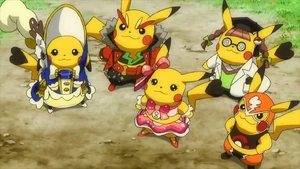
Main
Recurring
Minor
- Puka (Surflng Pikachu in the anime)
- Pikachutwo (a clone)
- Pikachu (TB039)
- Exam instructor's Pikachu
- Shopper's Pikachu
- Travis's Pikachu
- Aura Guardian's Pikachu
- Ayumi's Pikachu
- Mirror Ash's Pikachu
- Pikachu (MS018)
- Frank's Pikachu
- Spike
- Ash's Pikachu (MS020)
- Boss
- Curly
- Pikachu (SM091)
- Pikachu (PJ035)
- Mystery Dungeon Series
Manga

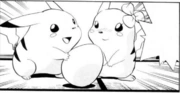
Pika and Chuchu.
In the Pokémon Adventures Manga, Red owns a Pikachu named "Pika" and Yellow also owns a Pikachu named "Chuchu".
Crossover
Super Smash Bros. series

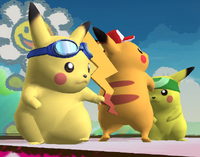
Pikachu's alternate costumes in Super Smash Bros. Brawl.
Pikachu has also appeared in all Super Smash Bros. series games. Pikachu is a very agile and mobile playable character. In Super Smash Bros., Pikachu was considered the strongest playable character. In Super Smash Bros. Melee, Pikachu's Skull Bash move was introduced, and its Quick Attack ability was upgraded so that it did a small amount of damage to opponents. Pikachu has also once again appeared in Super Smash Bros. Brawl as a playable character, with its exclusive attack Volt Tackle as its Final Smash. If you look at the hat Pikachu and you look at the shiny above and the hat, you would notice it's the Shiny Pikachu with Red's Japanese hat.
Each of Pikachu's alternate forms in Super Smash Bros. Brawl and Super Smash Bros. for Nintendo 3DS / Wii U can be seen as a tribute to different Pokémon games; The blue goggles come from Pokémon Colosseum and the red hat comes from the Kanto region games while the green headband comes from Pokémon Emerald Version. In the fourth title, one alternate form is that of Calem. Super Smash Bros. Ultimate gives Pikachu its two female alternates, one is based on Moon, and another is the Libre cosplay which is known appearing in Pokken Tournament (DX).
Along with Mario, Link, and Kirby, Pikachu is a mascot for the Super Smash Bros. series.
Mario franchise
Mario Artist: Paint Studio
Artwork of Pikachu from Pocket Monsters Red and Pocket Monsters Green is one of the usable stamps in Mario Artist: Paint Studio.
Super Mario Maker


Pikachu appears as a Costume Mario costume in Super Mario Maker, obtainable by collecting a Mystery Mushroom. The Pikachu costume is unlocked after the player either scans a Pikachu amiibo or completes the 100 Mario Challenge on Normal difficulty or higher.
Profiles
Websites
Play Nintendo
| Image | Description |
|---|---|
 |
Zap! This Pokémon has electric sacs on both its cheeks. Its opponents are in for a shock! Watch out when Pikachu raises its tail to check its surroundings, because lightning has been known to strike its tail when it does this! If you use a Thunder Stone on it, it will evolve into another Pokémon: Raichu. Explore Pokémon by type, weakness, abilities, and more at Pokemon.com.[2] |
amiibo
Pikachu has charmed fans and given a jolt to opponents for nearly 20 years—whether in the Pokémon TV series, the Pokémon Trading Card Game, or Pokémon video games, Pikachu has always been there as a stalwart companion for any Pokémon Trainer willing to take on the challenge of becoming the very best.
Trivia

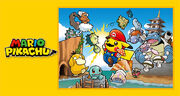
A Super Mario Bros.-based artwork associated with the Mario Pikachu line of merchandise
- Pikachu and Eevee are the only First partner Pokémon in the canon RPG games that deviates from the usual Grass, Fire, and Water-typings.
- Pikachu is the only Pokémon to have appeared in every episode, special, and movie in the series in some shape or form.
- Though Pikachu isn't in the Unova Pokédex, an image of it can be found in a building in Castelia City before the National Pokédex is obtained, as well as on a billboard above the Castelia City Pokémon Center. There are also several Pikachu shaped hedges in Striaton City. Also, there is a giant Pikachu float next to the Nimbasa City Gym.
- In Pokémon Battle Revolution, Pikachu can use the HMs Surf and Fly.
- Starting from Pokémon X and Y, Ikue Ōtani provides the voice of Pikachu in the place of a cry.
- In Super Smash Bros. Brawl, there are three variations of Pikachu. One has a headband similar to Brendan's hat, one has a hat similar to Ash's hat and another has goggles. The goggles variant is a reference to Pichu having an alt with goggles.
- Pikachu has appeared on more merchandise than any other Pokémon, including the limited edition Nintendo 64, Game Boy Color, Nintendo DS, and Nintendo 3DS consoles.
- In the 2011 Guinness World Records Book: Gamers Edition, Pikachu placed 20th in the "Top 50 VideoGame Characters of All Time".
- Pikachu is the Japanese mascot for the 2014 FIFA World Cup.
- Pikachu is the first Pokémon in Pokédex order to have a baby form.
- Pikachu and Meowth have inverse Pokédex numbers, 25 and 52. Coincidentally, they are based on a cat and a rodent. Even more coincidentally, Ash's Pikachu and Team Rocket's Meowth are rivals, like the popular cartoon, Tom and Jerry. (Ash and co. usually thwarting Team Rocket's various crazy schemes.)
- Having a Pikachu hold a Light Ball will double its Special Attack and Attack stats, making its stats higher than its evolution, Raichu. Raichu also cannot hold a Light Ball unless it evolves from a Pikachu that is holding one.
- Though not the first Pokémon created, Pikachu was the first Electric-type Pokémon created, conceived after the type was suggested to Sugimori and designed around the concept of electricity and the common symbol for lightning.
- Pikachu is one of Veronica Taylor's favourite Pokémon.
- A protein is named after Pikachu, the name of the protein is "pikachurin".
- Pikachu is one of the 16 Pokémon to be made into a puppet in Japan.
- A 2002 Carl's Jr toy features Pikachu playing the saxophone.
- A "Mario Pikachu" line of merchandise was released in Japan. It features a plush of Pikachu dressed as Mario and another of it dressed as Luigi. "Mario Pikachu" has an associated artwork parodying a Super Mario Bros. group artwork, with other Pokémon taking the place of Mario characters, such as Diancie for Princess Peach and Blastoise for Bowser.
- Pikachu is also a cartoon character that has big ears.
- Pikachu was originally set to have a third evolution named Goruchu, but the idea was scrapped.
- Special forms of Pikachu, such as Pikachu wearing hats, cannot evolve into Raichu.
- The Partner Pikachu in Pokémon: Let's Go, Pikachu! is shiny locked. This means that your partner cannot be a Shiny Pokémon.
- Pikachu's in-game cry for Generations II through V can be heard at 0:08 in the intro of Ed Sheeran's "Celestial" music video. [1]
- When the Pokémon franchise was localized in the US, Nintendo wanted to redesign every known Pokémon back then, including Pikachu, to be more appealing to American children. Therefore, Pikachu was initially redesigned into a tiger with huge breasts. Fortunately, this idea had been scrapped.
- Pikachu ranked 7th, among all Pokémon, in the Pokémon of the Year 2021 poll by The Pokémon Company. It also ranked 2nd among all Kanto Pokémon.
- Pikachu was once used by a malware programmer to bait a trojan horse that was meant to delete vital system folders on bootup. However, a bug in the code caused the virus to ask for permission to make the specified deletions.
Origin
Pokémon designer Atsuko Nishida stated that Pikachu originally resembled a mochi with ears. Nishida stated that no specific motif was given when she received the commission, and that she designed Pikachu based on the image of a squirrel, despite Pikachu being a mouse. The stripes on the back and the lightning bolt tail were added as details in the appearance, and the black ear tips are the remnant of an earlier design resembling a daifuku, a small Japanese dessert. It is also reminiscent of a viscaha, a rabbit-like rodent that lives in deserts and from the Chinchillidae family.
Its Gigantamax form appears to be based on earlier depictions of Pikachu when it debuted in Pokémon Red Version and Pokémon Green Version. During this time, its official artwork and sprites depicted it as fatter and rounder, though its Gigantamax form overall uses Pikachu's modern design while using the body shape of its earlier appearance.
Etymology
The name "Pikachu" was given by designer Atsuko Nishida. According to Ken Sugimori, Nishida, who was commissioned to design an Electric-type Pokémon, came up with the name "Pikachu" at the same time she completed the initial design.
Regarding the name "Pikachu," Nishida explained that she didn't think about it too deeply; "Pika" was included to indicate electricity, but "chu" was chosen simply for its sound and not because it meant "mouse." She also stated that the name "Pikachu" came first, and the mouse concept was developed afterward. Sugimori also stated that the name was decided later when Satoshi Tajiri was writing the character's background.[3][4]
In a 1999 interview with Time Asia magazine, Tajiri explained that Pikachu's name comes from the sound of an electric spark popping, and the sound of a mouse squeaking.[5]
While the names of many characters and Pokémon differ between the Japanese and non-Japanese versions, Pikachu is pronounced "Pikachu" universally, even though it is spelled differently. This is because Japan requested that the name be standardized worldwide.[citation needed]
Names in other languages
| Language | Name | Meaning |
|---|---|---|
| Japanese | ピカチュウ Pikachū (romanized) Pikachu (trademark) |
Combination of ピカピカ pikapika (onomatopoeia for sparkle) and チューチュー chūchū (the sound of mouse squeaking) |
| Arabic | بيكاتشو
Bīkātshū |
|
| Chinese | Hong Kong / Macau: 比卡超 Béikāchīu China / Taiwan: 皮卡丘 Píkǎqiū |
Transliteration of Japanese/English name |
| Indonesian | Pikacu (mangas only) | |
| Korean | 피카츄 Pikachu |
Transliteration of Japanese/English name |
| Russian | Пикачу Pikachu |
Transcription of Japanese/English name |
| Thai | ปิกะจู | Pikachu |
Gallery


.png "Pikachu (Super Smash Bros. Artwork).png (4 KB)")


_trophy_SSBM.png "Pikachu (Smash) trophy SSBM.png (669 KB)")
_trophy_SSBM.png "Pikachu (Smash 2) trophy SSBM.png (135 KB)")


_trophy_SSBWU.png "Pikachu (Alt.) trophy SSBWU.png (96 KB)")


.png "Pikachu (Pokkén Tournament).png (333 KB)")
.png "Pikachu Libre (Pokkén Tournament).png (969 KB)")


.png "Partner Pikachu (Let's Go).png (34 KB)")


.png "Pikachu (Super Smash Bros. for 3DS - WiiU Artwork).png (6.2 MB)")


References
- ^ Silvestri, Cris (2015). Pokémon Deluxe Essential Handbook [Book]. p. 282. Scholastic. ISBN 978-0-545-79566-1.
- ^ https://play.nintendo.com/themes/friends/pikachu/
- ^ "Pikachu's Origin Story". The Pokémon Company (archived). Retrieved December 8, 2025.
- ^ "ピカチュウは大福? 初めて明かされる誕生秘話". Yomirui.co.jp (in Japanese). Retrieved December 8, 2025.
- ^ "NOVEMBER 22, 1999 VOL. 154 NO. 20". CNN (archived). Retrieved December 8, 2025.
See also
- Official website data
- Pokémon Zukan Pokédex (Japanese)
- Pokémon Korea Pokédex (Korean)
- Pokémon Asia Pokédex: English, Chinese (Simplified), Chinese (Traditional), Thai, Indonesian, Vietnamese, Hindi
- Pokémon.com Pokédex: English, French, German, Spanish (European, Latin American), Italian
- Legendary Pokémon data
- The Pokémon Database
- Pokémon Dream Pokédex data
- Psypokes Psydex data
| Kanto | |
|---|---|
| Johto | |
| Hoenn | |
| Sinnoh | |
| Hisui | |
| Unova | |
| Kalos | |
| Alola | |
| Galar | |
| Paldea | |
| ??? | |
| Generation I | |
|---|---|
| Generation V | |
| Generation VII | |
| Generation VIII | |
| See also | |
| Pokémon | |
| #001–025 | |
|---|---|
| #026–050 | |
| #051–075 | |
| #076–100 | |
| #101–125 | |
| #126–150 | |
| #151 | |
| See also | |
| Generation I | |
| National Pokédex (list) | |||||||||||||||||||||||||||||||||||||||||||||||||||||||||||||||||||||||||||||||||||||||||||||||||||||||||||||||||||||||||||||||||||||||||||||||||||||||||||||||||||||||||||||||||||||||||||||||||||||||||||||||||||||||||||||||||||||||||||||||||||||||||||||||||||||||||||||||||||||||||||||||||||||||||||||||||||||||||||||||||||||||||||||||||||||||||||||||||||||||||||||||||||||||||||||||||||||||||||||||||||||||||||||||||||||||||||||||||||||||||||||||||||||||||||||||||||||||||||||||||||||||||||||||||||||||||||||||||||||||||||||||||||||||||||||||||||||||||||||||||||||||||||||||||||||||||||||||||||||||||||||||||||||||||||||||||||||||||||||||||||||||||||||||||||||||||||||||||||||||||||||||||||||||||||||||||||||||||||||||||||||||||||||||||||||||||||||||||||||||||||||||||||||||||||||||||||||||||||||||||||||||||||||||||||||||||||||||||||||||||||||||||||||||||||||||||||||||||||||||||||||||||||||||||||||||||||||||||||||||||||||||||||||||||||||||||||||||||||||||||||||||||||||||||||||||||
| |||||||||||||||||||||||||||||||||||||||||||||||||||||||||||||||||||||||||||||||||||||||||||||||||||||||||||||||||||||||||||||||||||||||||||||||||||||||||||||||||||||||||||||||||||||||||||||||||||||||||||||||||||||||||||||||||||||||||||||||||||||||||||||||||||||||||||||||||||||||||||||||||||||||||||||||||||||||||||||||||||||||||||||||||||||||||||||||||||||||||||||||||||||||||||||||||||||||||||||||||||||||||||||||||||||||||||||||||||||||||||||||||||||||||||||||||||||||||||||||||||||||||||||||||||||||||||||||||||||||||||||||||||||||||||||||||||||||||||||||||||||||||||||||||||||||||||||||||||||||||||||||||||||||||||||||||||||||||||||||||||||||||||||||||||||||||||||||||||||||||||||||||||||||||||||||||||||||||||||||||||||||||||||||||||||||||||||||||||||||||||||||||||||||||||||||||||||||||||||||||||||||||||||||||||||||||||||||||||||||||||||||||||||||||||||||||||||||||||||||||||||||||||||||||||||||||||||||||||||||||||||||||||||||||||||||||||||||||||||||||||||||||||||||||||||||||


